Thirty one frogs
I’ve been wanting to do visual art and especially 3D a bit more again (beyond demoscene stuff), and October is traditionally a month to do that kind of thing. I wasn’t sure at the start what kind of theme to go with (model a gun every day call it Glocktober? Just find someones inktober prompt list and just go with that? Just straight up do Kinktober?1). But conveniently, it came to me in a dream mutuals offhand joke:
Well then! I did actually manage to just about do one frog a day, some a bit more effort, some a bit less, and this is a retrospective.
Which frog turned out way better than expected?
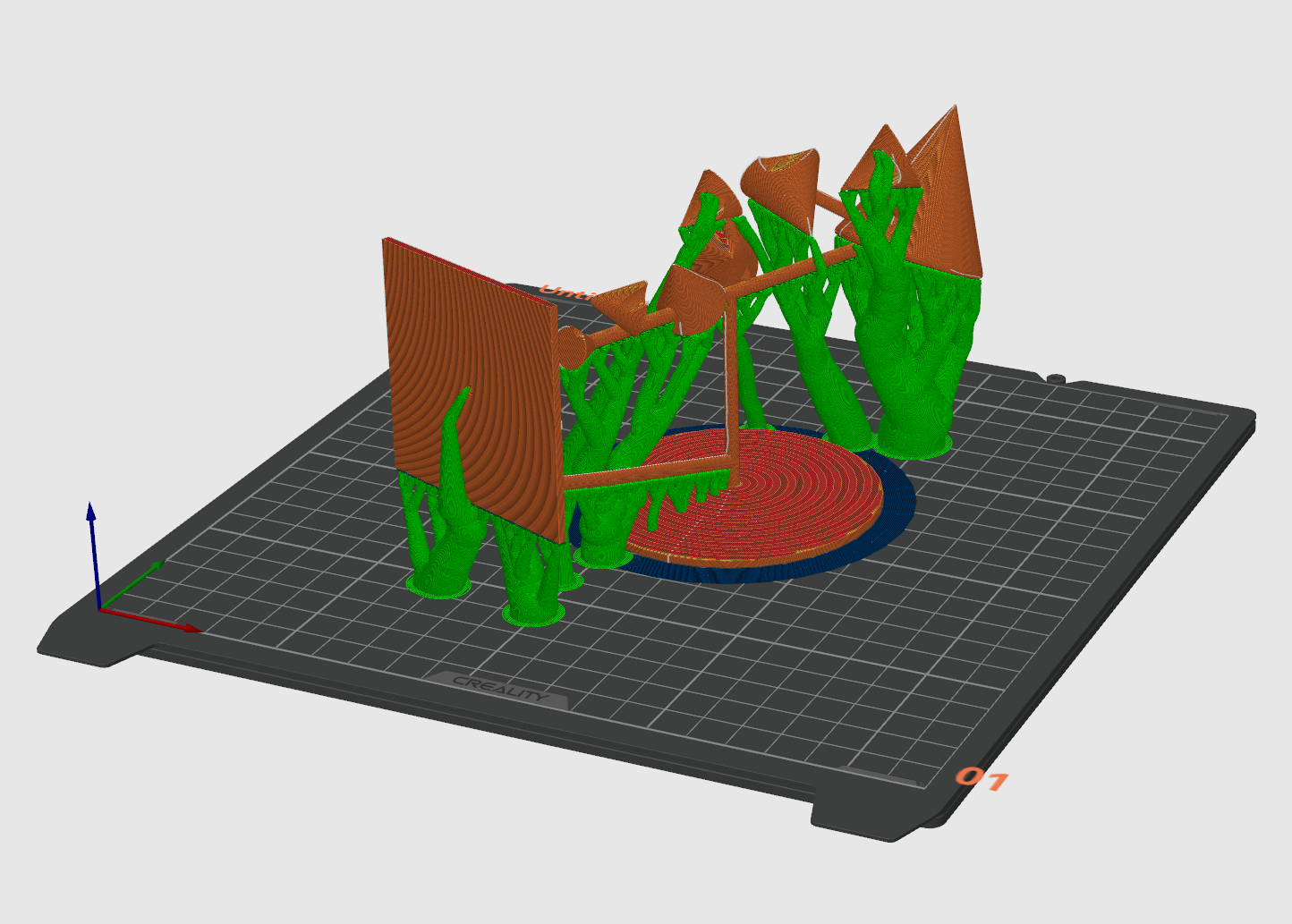
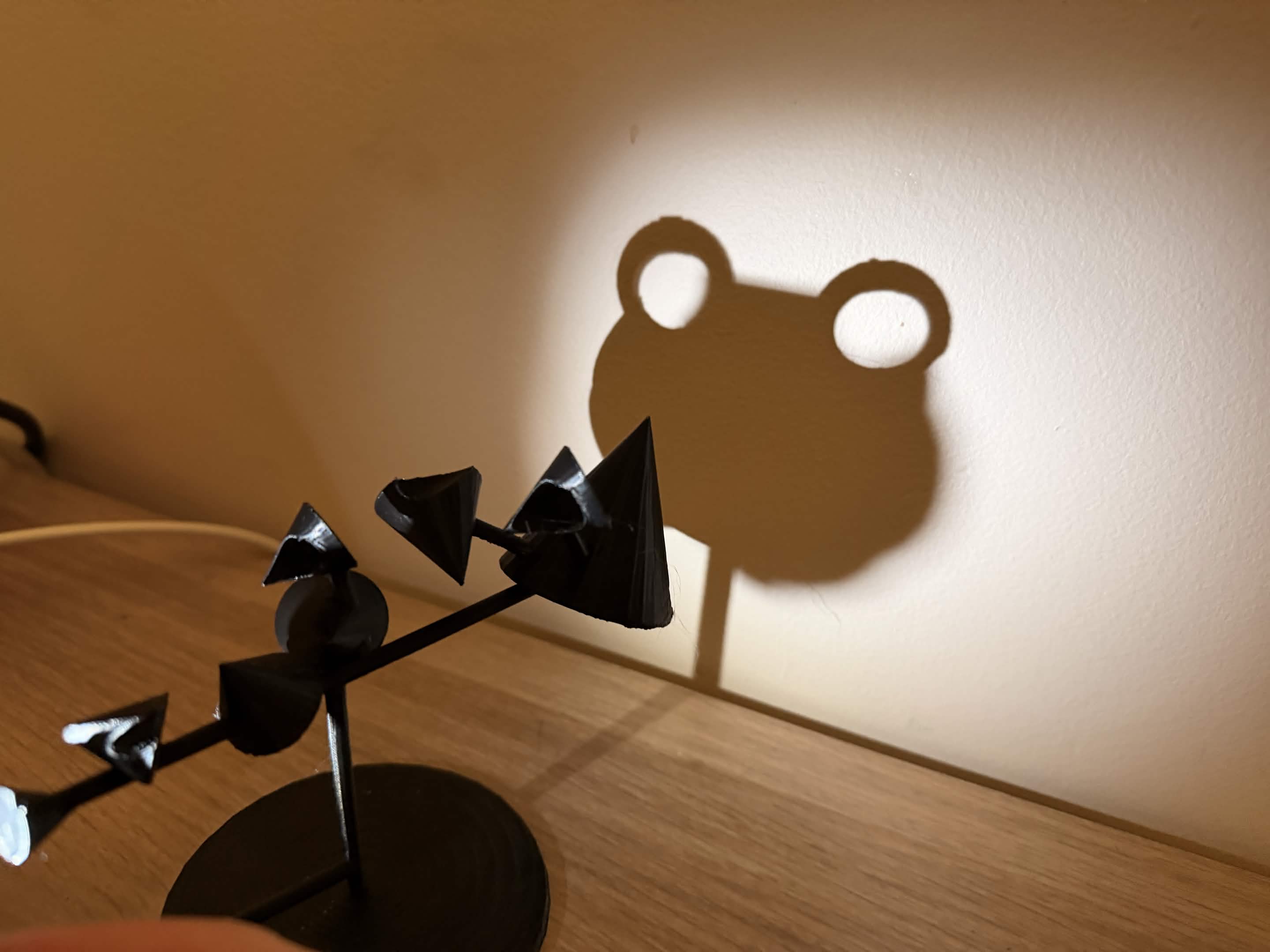
The shadow frog. This was already late in the month, when I was starting to run out of ideas. Playing around, and probably inspired by a bunch of stuff I saw at the ZKM2 at some point in the past, I came up with the idea of having a frog that is made from the combination of the shadows of a bunch of objects. To make it more interesting, I tried to stick with one type of object (a cone, because it’s relatively versatile with both round and sharp parts).
I started by adding a spotlight in blender and a plane, put a texture with the frog outline I wanted on the other side, and started arranging cones in a row, figuring out how to get the shadows to roughly match the outline on the plane. I then boolean’d out holes for the eyes from the whole thing. Finally, I removed the outline texture from te plane, and added a bunch of shading and elements to make the whole thing look more like an actual object in a museum.
The resulting object casts a frog shaped shadow, which you’d struggle to figure out without the light, and looks, in my opinion, really cool, especially when animated.
And thanks to the magic of highly accessible additive manufacturing technology, it can also be a real life object:
 |
 |
|---|---|
Which frog didn’t turn out quite as well as hoped?
I wanted to do a bunch of simulation in Blender for one of the frogs, and here, the idea I had was to fill a glass frog head with liquid and then put a bullet through it. I’ve done something similar before and I wanted to recreate it but frog. Unfortunately, unlike a glass of orange juice, the frog is really hard to actually identify as such after shattering, and there is too much liquid, and the simulation is kind of weird looking in places as well. This really just probably needed way more time to cook, that I wasn’t willing to put in. Oh well.
Which frog was the most work?
I’m going to split this between two entries, actually.
First off: Animated dancing frog! It’s based on this MV, which has a cute dance in it. I underestimated how long it would take to actually animate even just enough keyframes to make it halfway recognizeable. Once I had the technique down, it was pretty nice meditative sort of work, though. And I think I have some ideas about how I would rig my character different next time to make this kind of thing less painful3.
The other thing that took a long time was a small game. Not even the game itself so much, that’s a very simple (and, to be entirely honest, not that engaging) puzzle game. But rendering and re-rendering and re-re-rendering the assets until everything was Just Right was a pain, especially since for animated sprites the export “pipeline” involved Having EZGif.com Make Me A WebM, and took more than the day I initially wanted it to take.
Which frog did I learn most from?
I hadn’t really done any tracking and vfx stuff in a few years, and when I did all I really did was work through some basic tutorials. So there was a lot to figure out here: How to set up the shot so that it would be relatively easy to get the effect I want, using ML models for more stable tracking, eyeballing lighting and shadows and using a shadow catcher, masking out parts of the scene with relatively good precision, combining tracked footage and bone animation, putting it all together at the end and fixing colourspace issues4. While the animation itself could be a bit better, I do think the result is pretty fun to look at.
A frog I just couldn’t make work?
One idea I had was to make a pixel frog that is rendered as part of a Game of Life board, and then to work backwards to try and find a state that evolves into a state that contains that frog, or maybe even loops through it. This means solving a boolean satisfiability problem with quite a lot of variables.
I started by looking around a bit, and there wasn’t much information about doing this, which is probably not a good sign given how popular Conways Game of Life is with hackers. I did find one person who did it for three pixel letters on a tiny board. But anyways, we have faster computers now, right? How hard can it be? Lets just try with a basic circle outline first, then later the frog. Surely this will be quick and easy.
Very hard, as it turns out. I started with a slightly silly gradient descent based approach, implementing the forward step both as a proper hard update with straight-through estimator5, as well as a soft update using powered sigmoid, and interpolating betwen them. The forward pass is then just a sequence of these updates, and we backpropagate through them and try to find an initial state the minimizes the difference between the desired end state and the result of the forward pass using bog standard gradient descent, in several passes, ramping the number of steps up in every phase. That actually worked surprisingly okay, up to a point, but of course Game of Life is, while not quite a chaotic system, really sensitive to initial conditions in very annoying ways, and does not present a nice smooth surface for optimization.
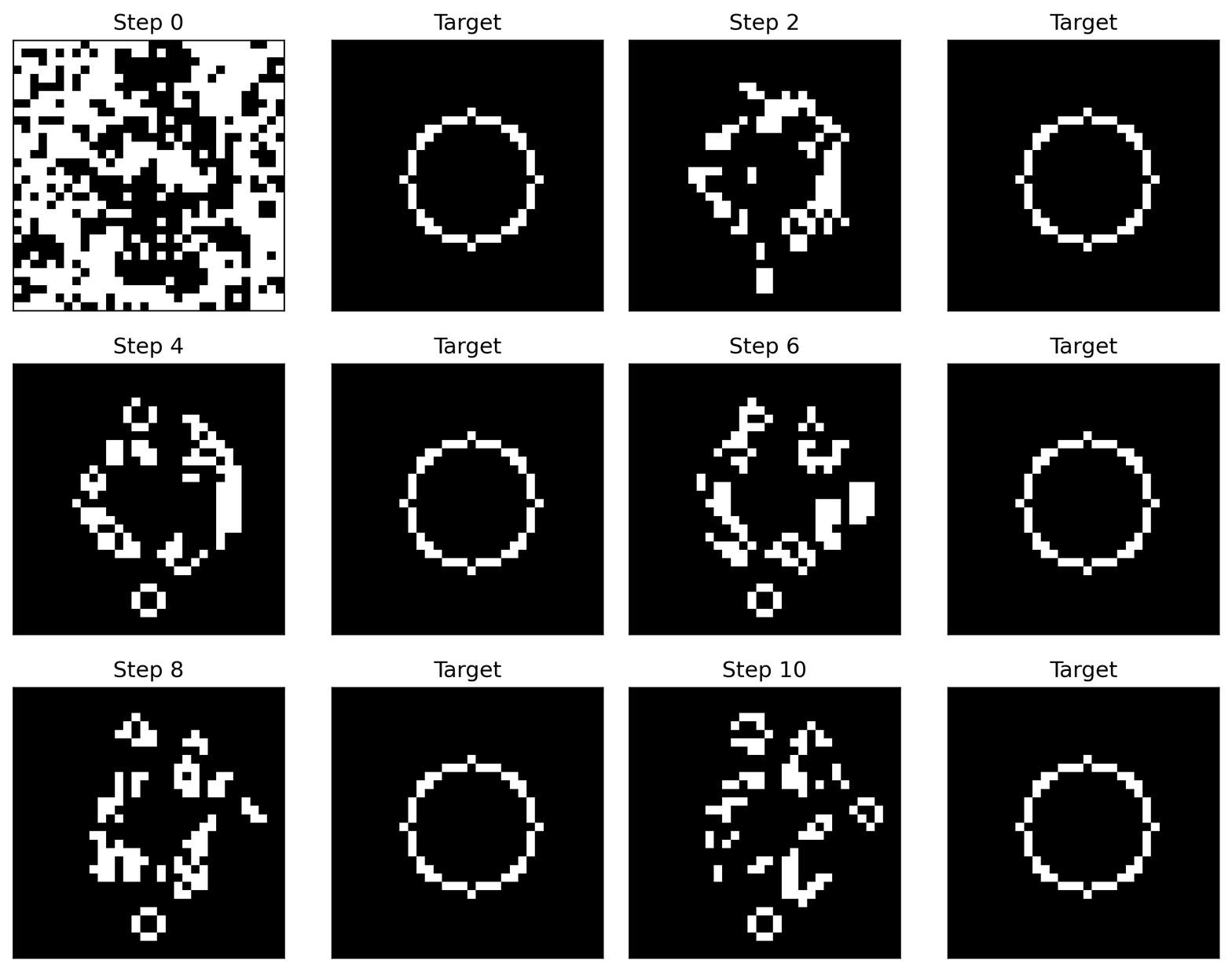
So instead, I just installed a SAT solver, defined my problem for it, and sent it on its merry way, and while it seemed to work in theory (it did almost immediately find a version of the circle that happens to be 100% stable with just a few changes, and a 3 step loop which is just the stable pattern plus a Blinker anywhere else on the board), it made absolutely zero progress on finding anything actually interesting for my circle over the course of one day and night and so I decided to just call it there. Maybe someday. It is a very interesting and fun problem.
Which frog from someone else did I really like?
It is Wednesday, my dudes.
Finally: Which of my frogs was my favourite?
First, a honorary mention to light painting. I came up with the idea for that a bit before october, and was playing around with it, but for this I went a lot further with it than before, and played around with how to present it more nicely. I think the flicker gif works really well.
But my actual favourite was a much simpler frog: The one I did relatively quickly while on the couch in the morning in TriangleDraw, an iOS app where you draw… with triangles. There’s just something about it. It looks really cool and kind of smug, it has a bit of symmetry but not too much? If my Masto account was on merveilles.town, I’d probably use this as my avatar.
If you want to look at any of my other frogs, please have a look at this thread right here, or if you want to look at mine and other peoples frogs, why not check out the hashtag!
-
I am absoluetly in no way brave enough to do that on main. ↩
-
Looking back, and oh god has it actually been more than 20 years, the Lichtkunst aus Kunstlicht exhibition at the ZKM was genuinely life changing for me. I have the giant catalog book somewhere still. ↩
-
Restrict arm movement axes and angles, for once, so it is harder to accidentally add a full rotation, and add a clear elbow indicator if the direction isn’t obvious from the character model. ↩
-
AAAAAAAAAAAAAAAAAAAAAAAAAAAAAAAAARRRRRRGGGGGGHHHHHHHHHHH ↩
-
There’s like, nothing about the straight-through estimator on wikipedia, which feels weird, given how it is a pretty foundational machine learning technique. ↩
| tagged: | 3d art blender |
| filed under: | a frankly unreasonable amount of frogs |
| give me money: | https://ko-fi.com/h4lcy |